AEO and SEO Difference: Discovering the Key to Search Clarity
⚡ TL;DR: This guide explains the aeo and seo difference, highlighting their unique roles in digital marketing strategies.
📋 What You’ll Learn
In this comprehensive guide about aeo and seo difference, we’ve compiled everything you need to know. Here’s what this covers:
- Learn the fundamentals of AEO – Understand how Answer Engine Optimization focuses on providing direct answers for voice searches.
- Discover SEO mechanics – Explore traditional Search Engine Optimization methods that improve website visibility on search engines.
- Understand the integration of AEO and SEO – Recognize how combining both strategies can enhance digital marketing effectiveness.
- Master voice search optimization techniques – Gain insights into optimizing content for evolving consumer behaviors and preferences.
The digital landscape has evolved rapidly, with the rise of voice search and AI-driven results fundamentally altering how consumers find information. Within this shift, the aeo and seo difference has emerged as a pivotal topic for marketers. Understanding this difference is not just academic; it has practical implications for how businesses can effectively engage with their target audiences. AEO, or Answer Engine Optimization, focuses on optimizing content for voice search and direct answers, while SEO, Search Engine Optimization, encompasses traditional methods for improving website visibility across search engines. The clarity on the aeo and seo difference can enhance digital strategies, aligning them with user behavior trends.
The challenge lies in integrating these two approaches. While SEO has long been the cornerstone of digital marketing strategies, AEO’s rise reflects changing consumer preferences. In a world where 55% of teenagers use voice search daily, as reported by Google, the implications of the aeo and seo difference cannot be overstated. Marketers must adapt to this new reality, crafting strategies that blend SEO’s traditional techniques with AEO’s innovative approaches to ensure visibility in an increasingly crowded digital marketplace.
Advanced Insights & Strategy
The integration of AEO and SEO into a cohesive digital marketing strategy requires a nuanced understanding of each approach’s strengths. AEO focuses on providing succinct, accurate answers to user queries, which aligns perfectly with voice search and AI-powered results. In contrast, SEO remains focused on traditional ranking factors like backlinks, keyword density, and content structure.
To develop a successful strategy, marketers should conduct comprehensive keyword research that includes natural language queries. This involves using tools like SEMrush and Ahrefs to identify phrases that users are likely to speak rather than type. Additionally, employing structured data markup can enhance AEO outcomes by helping search engines better understand the content context. For instance, a study by Moz indicated that sites using schema markup saw a 20% increase in click-through rates from search results.
Incorporating analytics is essential. Use platforms like Google Analytics to monitor engagement metrics and adjust strategies accordingly. A dynamic approach allows marketers to respond to shifting trends in user behavior, ensuring that both AEO and SEO efforts are aligned for optimal performance.
Understanding AEO: An Overview
AEO is a relatively recent addition to the digital marketing lexicon, yet it has quickly gained importance. Its focus on providing direct answers to user queries reflects a shift in how people consume information. With the rise of smart speakers and virtual assistants, optimization strategies have had to adapt to accommodate these technologies.
The core objective of AEO is to ensure that content is structured in a way that allows search engines to extract quick answers. This often involves utilizing features such as featured snippets, “People Also Ask” sections, and knowledge panels. For instance, when a user asks, “What is the capital of France?” AEO ensures that the answer, “Paris,” is readily available in an easily digestible format.
Brands like Home Depot have successfully utilized AEO strategies by optimizing their site for voice search. By implementing FAQ sections and leveraging structured data, they saw a significant increase in voice search visibility, leading to higher foot traffic in physical stores. This illustrates the tangible benefits of understanding and applying the intricacies of AEO.
Key Features of AEO
AEO is characterized by several key features that differentiate it from traditional SEO approaches. First, it prioritizes concise, accurate answers, often seeking to address user questions in as few words as possible. Second, it leverages technology such as structured data to provide context for search engines, enhancing the likelihood of being featured in voice search results.
Moreover, AEO is inherently dynamic. The nature of user inquiries evolves, necessitating continual updates to content strategies. Companies must stay ahead of emerging trends and adjust their content accordingly. This adaptability is essential in maintaining relevance in an ever-changing digital landscape.
Why AEO Matters Now
The significance of AEO cannot be overstated in a world where voice search is becoming increasingly prevalent. According to a report by Statista, the number of voice assistants is projected to reach 8.4 billion devices by 2024, surpassing the global population. Such statistics highlight the urgency for brands to adjust their strategies to cater to this growing audience.
Furthermore, AEO complements traditional SEO by enhancing user experience. By providing immediate answers, brands can improve engagement and build trust with their audiences. This shift toward user-centric content is not just a trend; it’s a fundamental change in how information is consumed and valued in the digital age.
The Mechanics of SEO
SEO has been the bedrock of digital marketing for many years, focusing on improving visibility across search engines through various techniques. Traditional SEO is built on several foundational elements, including keyword research, content optimization, and link-building strategies.
Effective keyword research is critical. Tools like Google Keyword Planner and Ubersuggest can help identify high-traffic keywords relevant to a brand’s audience. Once identified, these keywords should be incorporated thoughtfully into web content, ensuring both relevance and readability.
Content optimization involves not only the strategic placement of keywords but also the creation of high-quality, engaging content that addresses user needs. Google’s algorithms prioritize content that provides value, which means that depth and relevance are paramount. Brands like HubSpot exemplify this by consistently producing in-depth articles that rank well due to their comprehensive coverage of topics relevant to their audience.
Link-building remains a vital aspect of SEO. High-quality backlinks signal authority to search engines, enhancing a site’s credibility. Strategies for acquiring these links include guest blogging, partnerships, and creating shareable content that naturally attracts links.
SEO Techniques for 2024
As SEO evolves, staying updated with the latest best practices is crucial. Techniques such as optimizing for mobile search, as outlined by Google’s mobile-first indexing guidelines, are now standard. Mobile responsiveness is no longer optional; it is a necessity. Sites that are not optimized for mobile devices risk losing significant traffic.
Additionally, the importance of page speed cannot be overlooked. According to a study by Google, a delay of just one second in loading time can reduce conversions by 7%. Marketers must prioritize performance optimization to enhance user experience and SEO outcomes.
Voice search optimization is emerging as a critical focus area. As the lines between AEO and SEO blur, integrating strategies that cater to both approaches—like using natural language and optimizing for snippets—will become increasingly important.
Anticipating Algorithm Changes
Google’s algorithms are constantly evolving, making it essential for marketers to stay informed about changes and trends. Updates such as the BERT algorithm have shifted the focus toward understanding user intent rather than merely matching keywords. This shift emphasizes the need for contextually rich content that answers specific user queries.
Marketers should keep a pulse on industry news from reliable sources such as Search Engine Land and Moz to anticipate changes. Understanding these algorithm updates can provide a competitive edge, allowing marketers to adapt their strategies proactively rather than reactively.
Key Differences: AEO vs. SEO
Understanding the aeo and seo difference is essential for devising effective strategies in digital marketing. While both disciplines aim to enhance visibility and engagement, their methodologies and objectives differ significantly.
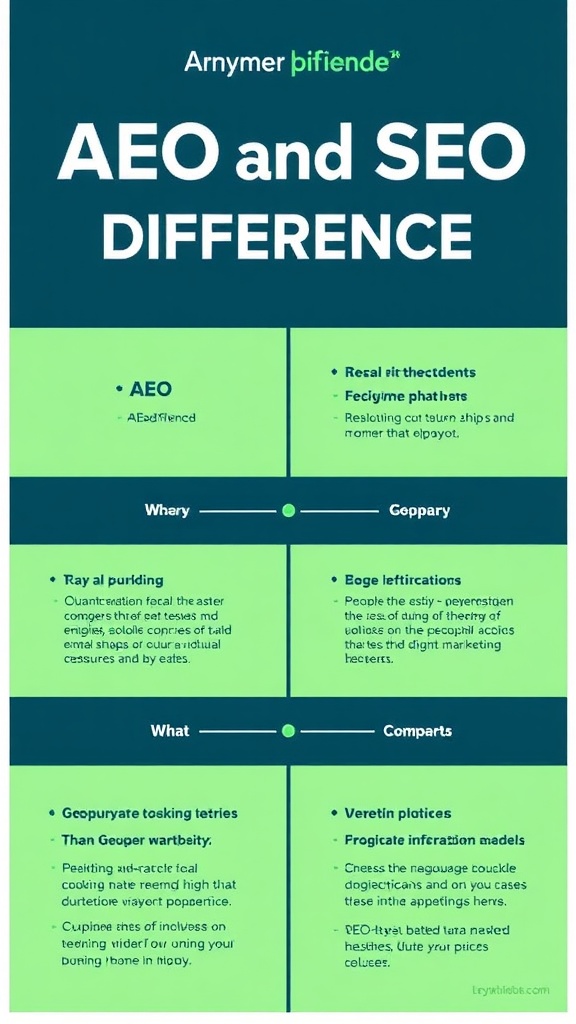
| Feature | AEO | SEO |
|——————|——————————————|——————————————|
| Focus | Direct answers to queries | Improving overall site visibility |
| Optimization Type| Content structure for voice search | Keyword density, backlinks, content quality |
| User Interaction | Immediate user engagement | Longer-term engagement via content |
| Technology | Utilizes structured data and rich snippets| Relies on traditional ranking factors |
The focus of AEO is on delivering concise answers to user questions, while SEO encompasses broader strategies for improving website visibility. This distinction is vital in crafting targeted marketing campaigns.
Brands that successfully navigate this aeo and seo difference can optimize their content for both traditional search and emerging voice technologies. For instance, companies like Nestle have adapted their strategies to cater to voice search, resulting in improved engagement metrics and increased brand loyalty. This adaptability to consumer behavior signals a progressive approach in modern marketing strategies.
Practical Implications of the AEO and SEO Difference
The implications of the aeo and seo difference extend beyond visibility; they impact overall marketing strategy and resource allocation. Understanding these distinctions allows businesses to prioritize efforts effectively. For instance, brands may choose to focus on AEO for product-specific queries while maintaining traditional SEO strategies for brand awareness campaigns.
Moreover, it encourages collaboration across teams. SEO specialists and content creators must work together to ensure that content not only ranks well but also meets the immediate needs of users seeking quick answers. This collaboration can lead to enhanced user engagement and improved conversion rates.
Integrating AEO and SEO Strategies
To effectively integrate AEO and SEO strategies, companies need to cultivate an agile mindset. This involves regular audits of existing content to identify opportunities for AEO optimization, such as implementing structured data and creating FAQ sections.
Marketers should also leverage analytics tools to monitor performance across both channels. By tracking metrics such as click-through rates from voice search versus traditional search, businesses can refine their strategies and allocate resources more effectively.
Additionally, creating a content calendar that incorporates both AEO and SEO tactics can streamline efforts. For instance, pairing blog posts that target long-tail keywords with optimized snippets for AEO can maximize visibility across platforms.
Impacts of AEO on Digital Marketing
The rise of AEO has significant implications for digital marketing strategies. As voice search continues to grow, understanding how to optimize for answers rather than traditional web pages becomes paramount. Brands that can effectively leverage AEO will likely see enhanced engagement and improved customer experiences.
AEO’s focus on direct answers aligns with consumer preferences for quick, accessible information. According to a report by Comscore, 50% of all searches will be voice searches by 2025. This statistic highlights the urgency for marketers to adapt their strategies to meet changing consumer behaviors.
The impact of AEO on customer engagement is evident in brands that have embraced these strategies. For example, Domino’s Pizza has integrated voice ordering capabilities, allowing customers to place orders via smart speakers, demonstrating a direct application of AEO principles to enhance customer interaction.
Redefining Customer Experience
AEO has fundamentally altered the customer experience by prioritizing immediacy and accessibility. Businesses that provide quick, accurate answers are more likely to build trust and loyalty among consumers. This shift necessitates that companies rethink their content strategies to focus on user-centric answers rather than lengthy articles that may not address specific queries.
Moreover, brands are increasingly utilizing chatbots and AI to facilitate AEO. These technologies can provide instant responses to customer inquiries, further enhancing user experience and satisfaction. A study by Salesforce found that 69% of consumers prefer to use chatbots for quick communication, underscoring the importance of this trend.
This emphasis on responsive engagement is not just a competitive advantage; it is becoming a standard expectation among consumers. Brands that fail to adapt risk losing relevance in an increasingly fast-paced digital environment.
Future Trends in AEO
Looking ahead, several trends are likely to shape the future of AEO in digital marketing. The integration of artificial intelligence and machine learning will further refine how answers are generated and presented to users. As algorithms become more sophisticated, the ability to provide personalized and contextually relevant answers will become essential.
Additionally, the rise of multimodal search—where users interact through both visual and verbal queries—will necessitate a more integrated approach to AEO. Brands will need to ensure that their content is optimized not only for voice search but also for visual platforms like Instagram and Pinterest.
The implications of these trends are profound, suggesting that the aeo and seo difference will continue to evolve, requiring marketers to remain agile and responsive to emerging technologies. Keeping abreast of these changes will be crucial for maintaining a competitive edge in the digital marketplace.
Frequently Asked Questions About aeo and seo difference
What are the primary differences between AEO and SEO?
The primary differences lie in focus and methodology. AEO emphasizes delivering direct answers to user queries, particularly for voice search, while SEO concentrates on improving overall website visibility through keyword optimization and link building.
How can businesses integrate AEO into their existing SEO strategies?
Businesses can integrate AEO by optimizing content for voice search, utilizing structured data, and creating FAQs that address specific user queries. Regularly updating content based on analytics can also enhance both AEO and SEO strategies.
Why is understanding the aeo and seo difference important for marketers?
Understanding the aeo and seo difference is crucial for marketers as it informs content strategy, resource allocation, and engagement tactics. It allows businesses to tailor their approaches to meet changing consumer behaviors and preferences effectively.
What role does user intent play in AEO and SEO?
User intent plays a significant role in both AEO and SEO. AEO focuses on answering specific queries quickly, while SEO aims to align content with user intent for better engagement and visibility. Understanding intent helps create more relevant content.

How is voice search impacting the aeo and seo difference?
Voice search significantly impacts the aeo and seo difference by shifting the focus toward concise, direct answers rather than traditional web pages. Marketers must adapt strategies to optimize for voice queries and improve user experience in this context.
What are some effective AEO strategies for businesses?
Effective AEO strategies include implementing structured data, optimizing for snippets, and creating concise content that directly addresses user questions. Regularly monitoring user queries and adjusting content can further enhance AEO performance.
How does structured data influence AEO?
Structured data influences AEO by providing search engines with context about content, making it easier to extract quick answers. This can lead to higher visibility in voice search results and featured snippets, enhancing user engagement.
What is the future of AEO in digital marketing?
The future of AEO in digital marketing is likely to involve greater integration of AI and machine learning, enhancing the ability to provide personalized, contextually relevant answers. Emerging technologies will reshape how brands engage with consumers through voice and visual search.
Conclusion
The aeo and seo difference is not just a theoretical concept; it has real implications for how brands engage with their audiences in the digital space. As the landscape continues to evolve, understanding these distinctions will be crucial for marketers looking to stay relevant. By embracing both AEO and SEO strategies, businesses can enhance visibility, improve user experience, and drive engagement in an increasingly competitive marketplace.

Find out more information about “aeo and seo difference”
Search for more resources and information: